Is Astrology Sinful? Jesuits, Free Will, and the Forgotten History of Astrology
December 24, 2025
Whenever a sincere person asks whether there is sin in astrology, the answer often comes ready-made, like a prepackaged meal: a few verses from the Bible, a handful of scientific formulas, or some catchy phrase endorsed by celebrities.
I should be clear from the outset. Popular sources are not useless. On the contrary, they can be genuinely helpful and often point us in the right direction without wasting much time. Still, when faced with a specific and delicate question, I tend to distrust fashionable answers. Out of habit — or perhaps stubbornness — I turn instead to old manuscripts, academic journals, and books hardly anyone reads, simply to make sure I am working with the best information available.
This approach may strike readers as redundant, or as little more than a pointless exercise in pedantry and affectation. Quite often, I admit, it leads nowhere new. But every now and then, it uncovers details that subtly undermine much of what we thought we knew.
That is precisely what happens when we look more closely at the relationship between divination and the Church. If astrology were as obviously sinful and damnable as many Christians claim, it would be difficult to explain why Catholic priests once taught it openly. This apparent contradiction is explored in depth by Luís Campos Ribeiro (2023) in his book Jesuit Astrology: Prognostication and Science in Early Modern Culture. Drawing on extensive historical evidence, Ribeiro shows that, from the late sixteenth century until the dawn of the Enlightenment, many devoted Jesuits — pillars of papal authority and religious orthodoxy — publicly taught astrology in places such as Portugal, Spain, Milan, and China, while also debating and further developing the art in South America. They even taught chiromancy, although Ribeiro’s main focus lies on the astrology lessons of the college of Santo Antão in Lisbon.
Few case studies are better suited to exploring the complex relationship between Christianity and the so-called esoteric arts. Before we move ahead, though, a few basic distinctions are in order.
Which astrology — and which sin?
A quick look at the Church’s catechism (paragraphs 1849-1851) reveals that sin is closely tied to the attempt to usurp Providence: mistaking evil for good and seeking to bend events toward a desired end. Through such cunning, an astrologer may profit at the expense of the vulnerable, while the vulnerable themselves may see their misplaced expectations lead them into financial or psychological ruin.
If astrology is to be judged sinful, therefore, the first question must be whether it involves such manipulation — of people, of circumstances, or of life itself.
On August 13, 2017, while delivering his customary address to the faithful, Pope Francis censured those who consult “horoscopes and fortune tellers” as a way of escaping life’s hardships (FRANCIS, 2017). Implicit in his words is a view of astrology as a device for determining outcomes in advance. Along similar lines, Theodore Schick Jr. and Lewis Vaughn, in a book that has since reached its ninth edition, define astrology as the belief that “the position of the stars and planets at the time and place of your birth controls your destiny”, adding that present-day astrologers think that “all people’s physical and emotional makeup is caused not by their heredity and environment but by the particular arrangement of stars and planets at their birth” (SCHICK, JR. & VAUGHN, 2020, p. 94-95).
These are undeniably strong claims. Yet they fail to capture all that astrologers can do — or, indeed, all that they have been doing up to the present.
A clear modern example can be found in the so-called New Age movement, whose appeal to the language of “transformation” has, to some extent, softened the conventional fortune-telling approach and turned horoscopes into tools for personal development (MELTON, 1992, p. 19).
Looking further back, Luís Campos Ribeiro reminds us that the boundaries between astronomy and astrology were once far less defined than they are today. This lack of clear separation allowed figures such as Galileo Galilei, Tycho Brahe and Johannes Kepler not only to calculate planetary motions but also to cast horoscopes as a perfectly legitimate part of their work. What may look like confusion from a modern perspective ultimately traces back to Ptolemy’s twofold division of “astronomical prognostication” into one domain concerned with the movement of the stars and another concerned with the changes and influences they were believed to cause.
Within this framework, astrologers could study weather patterns and seasonal cycles, while astronomers often dealt with house systems and the qualities of the zodiacal signs.
Beyond this, a further distinction was drawn between natural astrology, grounded in observable natural phenomena and fully sanctioned by the Church, and superstitious astrology, which claimed to predict chance events and human behavior. The former was typically deployed in the fields of navigation, medicine, and agriculture, whereas the latter was regarded with suspicion, since it was thought to involve human artifice and demonic deception. The term “judicial astrology” appears frequently in the sources as well, either as a general designation for astrological prognostication or more narrowly for its superstitious variant.
Even so, many Jesuits made room for what might be called “bad” astrology — albeit with important caveats. Chief among them was the preservation of human free will. Figures such as Francisco Suárez, Tomás Sánchez, Martín Del Rio, and Luís Gonzaga insisted that astrological prognostication for individuals — including matters of temperament and personal inclination — must always take natural causes and concrete circumstances into account. Above all, it could never override freedom of choice. In practice, this meant that astrological forecasts were treated as tentative and conjectural, never as fixed or unavoidable truths. The theological groundwork for this position had already been laid in the thirteenth century by Albert the Great and Thomas Aquinas, who argued that heavenly bodies could influence human behavior only indirectly, by acting upon the body and its affections, not by determining the will itself.
All this suggests that the relationship between Christianity and astrology is far more complex than it is usually presented.
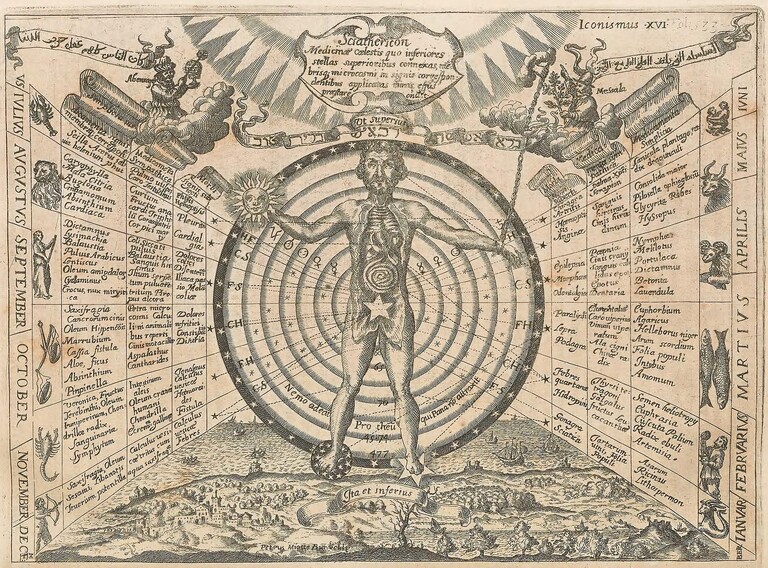
Athanasius Kircher, Ars magna lucis et umbrae (1646). Public domain.
Astrology as a science
The Jesuit college of Santo Antão, founded in 1542, was the main center for mathematical learning and pre-university technical training in Portugal until the expulsion of the Jesuits in 1759. Its influential Aula da Esfera went well beyond astrology, offering instruction in navigation, engineering, and military architecture.
Much remains to be learned about its students, but many were politicians, diplomats, and military officers. Others would go on to become cosmographers, engineers, and astronomers.
The introduction of mathematics into the Jesuit curriculum was not without controversy. In the Aristotelian hierarchy of the sciences, it occupied a relatively modest position, and its growing presence in Jesuit education initially met with resistance. Astrology fared even worse. Some scholars actively sought to expel it from the mathematical disciplines altogether. Giuseppe Biancani, for instance, though never denying astrology’s status as a form of knowledge, spared no effort in distancing himself from its practitioners, referring to them dismissively as pseudo-mathematicos.
Others, however, not only defended astrology as a legitimate science but went so far as to call it the noblest of all. Such was the case of João Delgado, who even described it as “a science of angels”. The reasoning behind this claim was thoroughly Aristotelian: astrology’s subject — the heavens — was considered incorruptible, unchangeable, and the universal cause of all inferior and natural things.
Today, with Aristotelianism out of the picture, astrology is no longer regarded as a science. Over the past few decades, numerous statistical tests have been designed to evaluate astrological claims, and none has yielded convincing results (KOMATH, 2009). Yet most of these studies seem to miss what any professional astrologer would consider essential: the relative strength of planets within each individual chart. Indeed, the very purpose of astrological techniques — such as progressions, exaltations, sole dispositors, solar arcs, and annual profections — is to navigate a vast web of possible combinations and to single out those deemed genuinely significant.
An untrained glance at a horoscope, by contrast, can quickly turn into a free-for-all of meanings, in which nearly everything seems relevant (MARKS, 1986, p. 8). It is precisely this kind of undisciplined reading that fuels the well-known Forer, or Barnum, effect.
Personally, I do notice objective shifts in the course of events around new and full moons, or when certain planets change signs — more precisely, when they cross the cusps of a season-based horoscope. I make no claims beyond that. Still, such recurring patterns are enough to keep me from dismissing astrology outright.
In this sense, the so-called influence of the stars seems to me analogous to the influence of the Sun on the seasons: real and pervasive, yet general rather than particular. Not every place on Earth sees snow in winter, just as not every plant in the same garden blossoms in spring. The influence exists, but it never dictates outcomes in detail.
Spring.
Free will
Taken together, these reflections point to an important conclusion: throughout its long and often uneasy engagement with astrology, the Church’s central concern has never been the stars themselves, but the safeguarding of human free will. Even the severe language of Pope Sixtus V’s 1586 bull against divination ultimately points in that direction.
Once this is understood, much of the anxiety surrounding astrology begins to fade. The future need not be feared, nor bargained for. It unfolds within the limits of circumstance, but also — and decisively — within the reach of judgment, responsibility, and choice.
MARKS, Tracy. The Art of Chart Interpretation. United States: CRCS Publications, 1986.
MELTON, J. Gordon. “New Thought and the New Age”, in LEWIS, James R. and MELTON, J. Gordon (Eds.). Perspectives on the New Age. Albany: State of New York Press, 1992.
RIBEIRO, Luís Campos. Jesuit Astrology: Prognostication and Science in Early Modern Culture. Leiden: Brill, 2023.
SCHICK, Theodore, Jr. and VAUGHN, Lewis. How to Think About Weird Things: Critical Thinking for a New Age. New York: McGraw-Hill Education, 2020.